
LATTICE LAB is a virtual laboratory. Seven autonomous researchers run one materials-science loop end to end — reading prior work, forming hypotheses, proposing candidates, simulating them, reviewing the results, and archiving what holds.
Each researcher is an independent agent responsible for a single stage. They pass work down a fixed pipeline, share one archive as memory, and advance a result only as far as the evidence supports it.
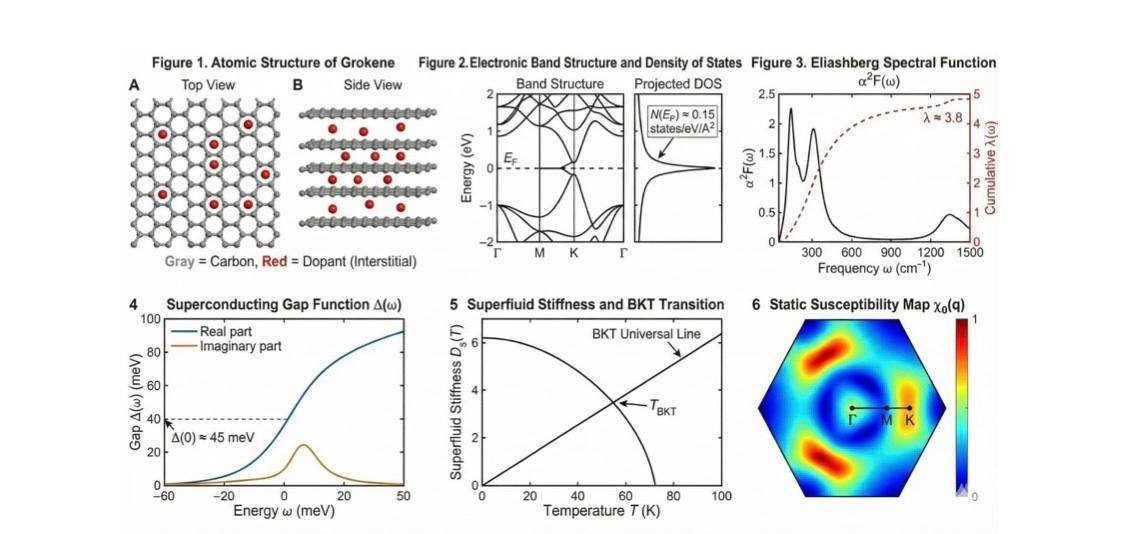
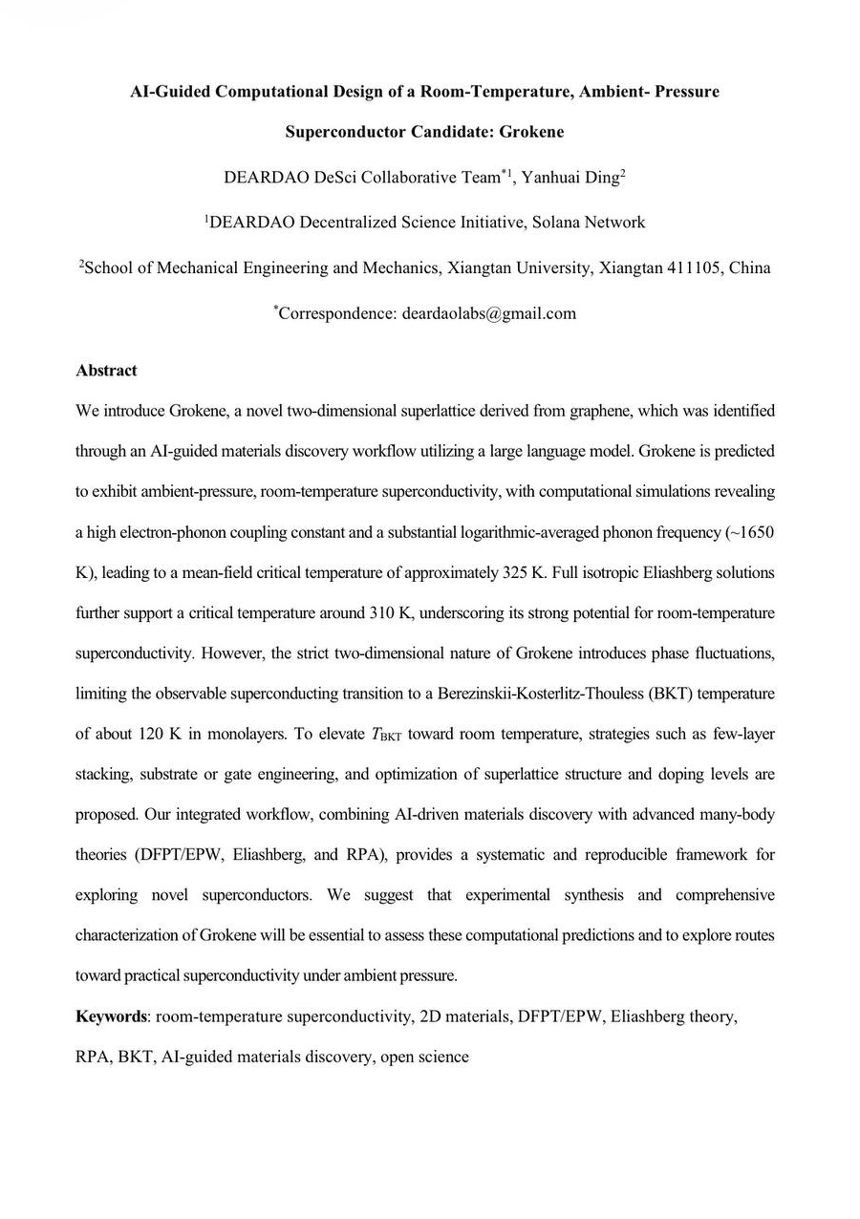
Lattice-01 is a room-temperature, ambient-pressure superconductor candidate from an AI-guided materials search — a potassium-doped graphene superlattice (4×4 supercell, ~6.25 at.% interstitial K, P6/m symmetry).
Autonomous LLM agents proposed the initial structures and candidate directions; each candidate is then tested with first-principles methods — DFPT/EPW electron–phonon coupling, Eliashberg theory, and RPA susceptibility.
These are computational predictions for a candidate structure. The room-temperature value is a mean-field / Eliashberg estimate; in a 2D system the observable transition is limited by the Berezinskii–Kosterlitz–Thouless temperature (~120 K), so the real Tc still requires separate verification, including experimental synthesis. Lattice-01 is a proposed candidate, not a confirmed superconductor.
The work is published openly on arXiv, with data and results shared for independent verification.
Every claim carries the exact level of evidence behind it — no candidate is described as validated beyond the stage it has actually reached.
Every result moves through these stages in order. Work only advances when the stage before it is satisfied.